Adult
Ages 18–64
€23per person
Open-date entry
- Full palace entry (all 14 rooms + kitchens)
- Skip-the-line priority queue
- 5-minute audio history sent before your visit
- 24/7 concierge in your language — before, during and after your visit
Palácio Nacional de Sintra · the palace on the square
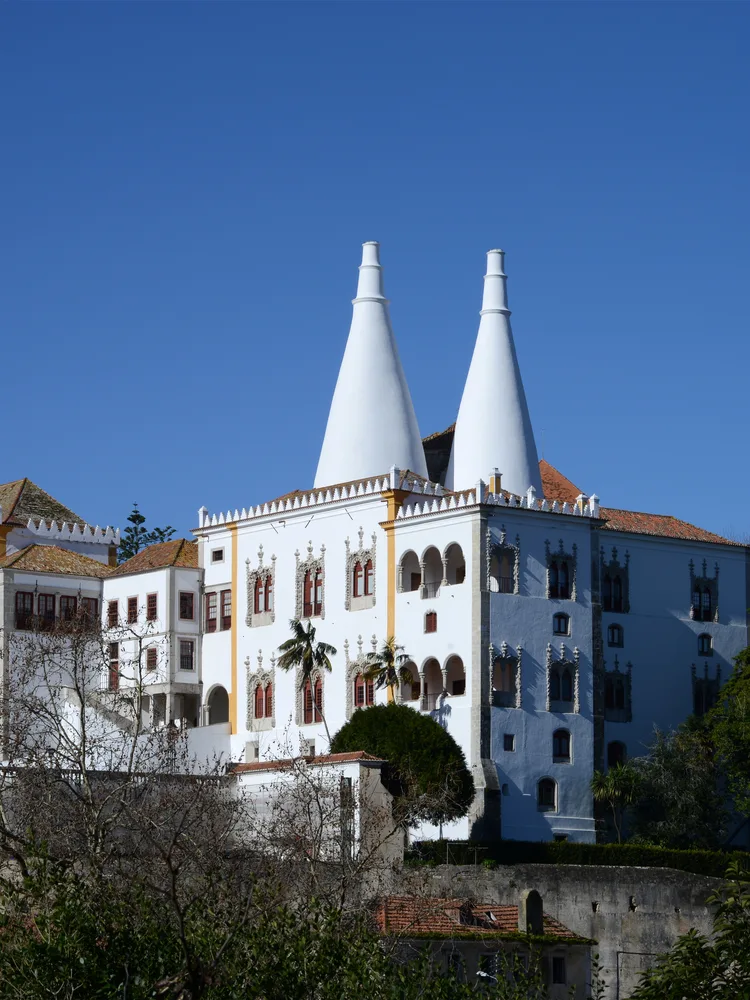
Sintra National Palace skip-the-line — twin conical chimneys, 500 years of Portuguese kings, Mudéjar and Manueline tilework you'll find nowhere else. In Sintra's old town, not on the hilltop.
Open-date ticket: you pick the visit day at checkout, and there is no time slot to hit.
Peak-season weekends (May–Sep) queue 30–45 min at the ticket office — skip-the-line bypasses it.
Kitchen ledger
Adult, youth and senior entries are priced per person; the family entry covers two adults and two youths on a single line.
Ages 18–64
€23per person
Open-date entry
Ages 6–17
€20per person
Open-date entry
Ages 65+
€20per person
Open-date entry
2 adults + 2 youths
€45per family
Open-date entry
Every entry is open-date: choose the visit day at checkout, then walk up to the palace door on the square at any point that day.
Under the chimneys
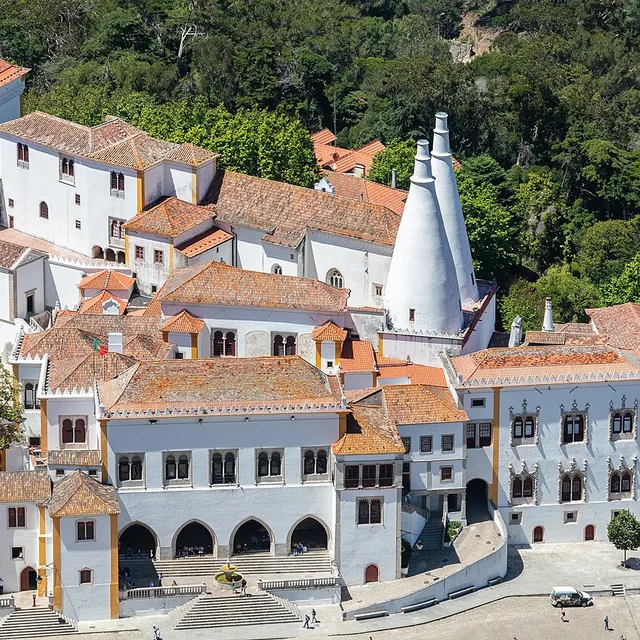
From the square to the domed hall of shields, the palace in the order you will meet it.
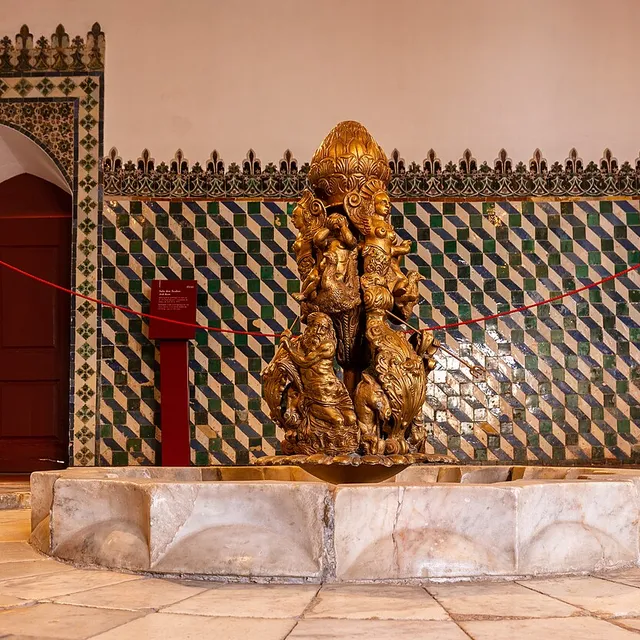
Mudéjar tile quartet
Four numbers that explain why this house in the town, and not the one on the hilltop, held the Portuguese court for so long.
Painted ceiling
Room inlay
The Palácio Nacional de Sintra sits in the old town of Sintra, at the foot of the Sintra mountains — not to be confused with the yellow-and-red Pena Palace that tops the hill above it. This was the royal summer residence continuously from the 12th century until 1910, which makes it the longest-used royal palace in Portugal. Every king of Portugal stayed here; Catherine of Braganza was born here.
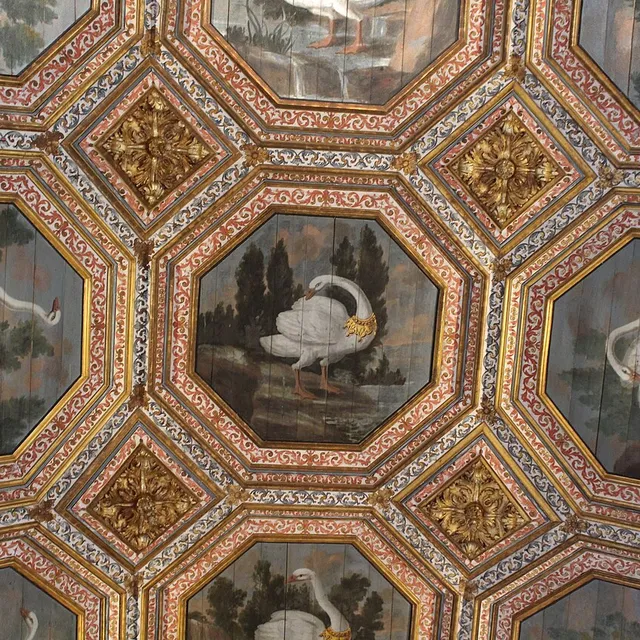
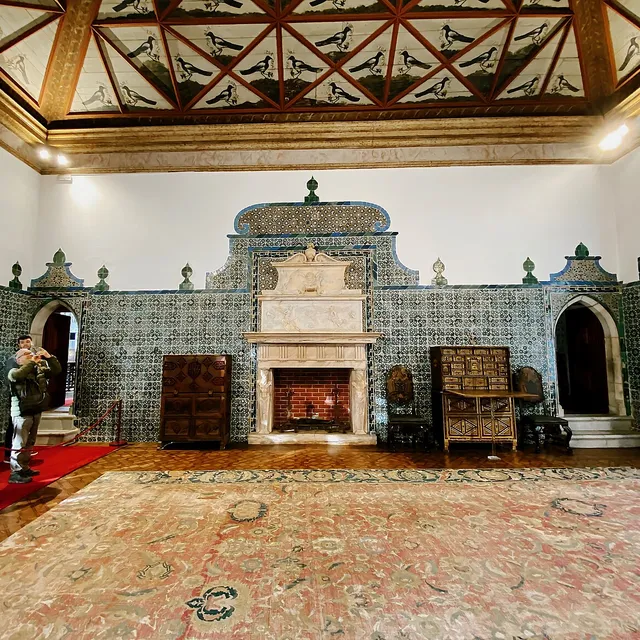
Architecturally it's a layered thing — Moorish bones from before the Christian conquest, a core built by João I in the 14th century, major expansion by Manuel I in the early 16th. The result is an astonishing blend: Mudéjar azulejos that predate anything Spain kept, Gothic vaults, Manueline windows, and the only surviving major painted ceilings of the medieval Portuguese court (the Hall of Swans with 27 gold-crowned swans, the Hall of Magpies with 136 birds on the ceiling).
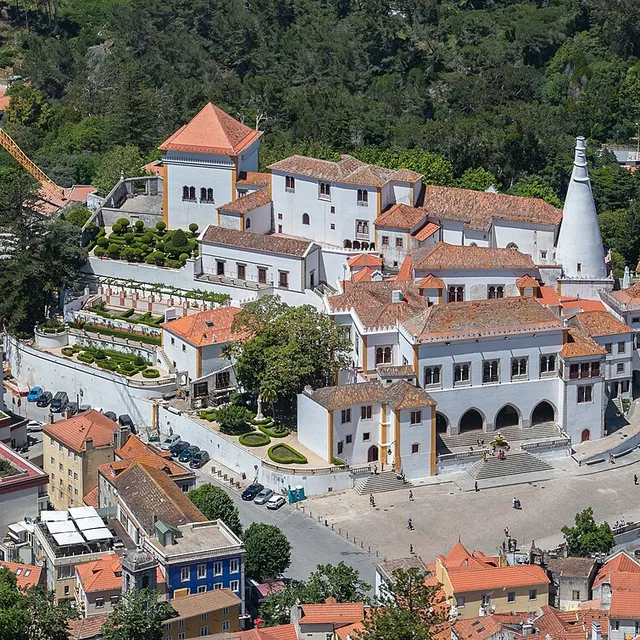
The twin conical chimneys are a 14th-century industrial-kitchen solution to feeding the court — they vent a pair of three-storey kitchens big enough to roast whole oxen. They've become Sintra's silhouette: you can see them from the train window on the approach from Lisbon.
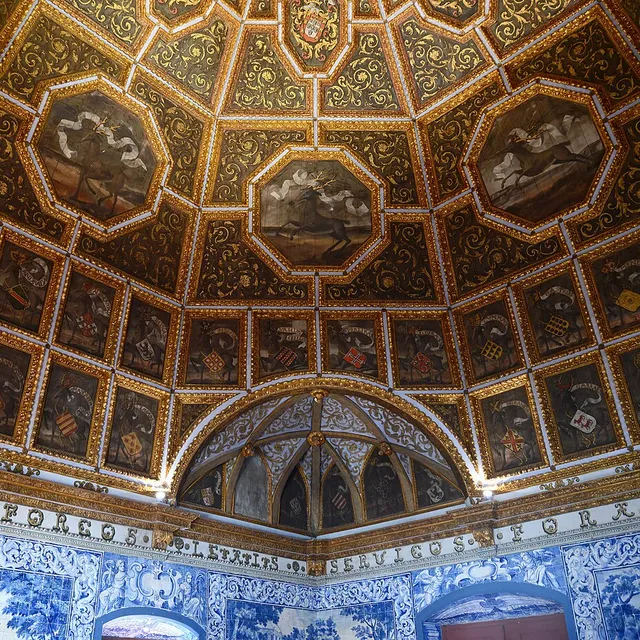
Beyond the famous painted ceilings, your Sintra National Palace tickets open the Sala dos Brasões, a Manueline hall crowned by a gold dome bearing the heraldic shields of 72 noble families and the arms of King Manuel I. Nearby, the Sala dos Árabes centres on a Mudéjar fountain ringed by some of the oldest azulejo tilework on the Iberian Peninsula. These rooms trace two great building campaigns — João I in the 15th century, Manuel I in the early 16th — layered over the palace's earlier Moorish bones.
Old-town wayfinding
Entry plaque
Good to know:Peak-season weekends (May–Sep) queue 30–45 min at the ticket office — skip-the-line bypasses it.
Train-window briefing
A short, calm narrative — five hundred years of Portuguese kings, the ceilings of magpies and swans, and what to look for in the medieval kitchens. Listen on the train from Lisbon.
Press play as the Rossio train leaves; it finishes before you reach Sintra station.On the recording
Rossio departures
In this guide
In this guide
In this guide
In this guide
In this guide
Coats-of-arms index
Seventy-two noble families hang in the domed hall; these ten questions cover most of what visitors ask us before they book.
The Palácio Nacional de Sintra (Sintra National Palace) is the best-preserved medieval royal residence in Portugal — used continuously by the Portuguese crown from at least the early 15th century to the fall of the monarchy in 1910 — sitting in the historic centre of Sintra town, marked by its unmistakable twin white conical kitchen chimneys. This guide covers what you'll see inside, how to get there from Lisbon, current opening hours, what a sensible visit looks like, and how it pairs with the other Sintra monuments.
Palácio Nacional de Sintra is a medieval royal palace in the historic centre of Sintra town in Portugal, recognisable for its twin white conical kitchen chimneys rising 33 metres above the rooftops. It is the best-preserved medieval royal residence in Portugal and was used continuously by the Portuguese crown from at least the early 15th century until the 1910 republican revolution. The site was originally a Moorish residence reclaimed by King Afonso Henriques in the 12th century, but the building visitors see today is the work of two great construction campaigns under King João I in the early 15th century and King Manuel I in the early 16th. UNESCO inscribed the palace in 1995 as part of the Cultural Landscape of Sintra. The address is Largo Rainha D. Amélia, 2710-616 Sintra. The palace is operated by Parques de Sintra – Monte da Lua, S.A.
The palace blends Gothic, Manueline, Mudéjar, and Moorish architecture into a single connected complex of roughly twenty-one rooms across multiple levels. Its highlight interiors include the Sala dos Cisnes (Swan Room), the Sala das Pegas (Magpie Room), the Sala dos Brasões with its gold-domed ceiling of 72 noble heraldic shields, the Sala dos Árabes with its Mudéjar tilework and central fountain, the Royal Chapel under Mudéjar arches, and the medieval kitchens beneath the twin chimneys. Catherine of Braganza — later Queen of England — was born here. Parques de Sintra runs the palace today as one of four Sintra-cluster monuments alongside Pena Palace, the Moorish Castle, and Monserrate. Sintra National Palace sits in the town centre on flat ground, not on the mountain — a frequent confusion with Pena Palace, which is the colourful 19th-century palace on the ridge above.
Plan about 75 to 90 minutes door-to-door from central Lisbon to Palácio Nacional de Sintra. CP (Comboios de Portugal) runs the Sintra Line from Rossio, Oriente, and Entrecampos stations roughly every 20 minutes; the journey takes about 40 minutes. From Sintra railway station, the palace is a 10–15 minute walk downhill into the historic town centre, or one short stop on the 434 tourist-bus loop at Volta do Duche. Unlike Pena Palace on the mountain ridge, Palácio Nacional sits on flat ground in the town square at Largo Rainha D. Amélia, so most visitors simply walk. The cobbled streets are uneven but well signposted from the station — the twin white conical chimneys are visible from much of the town centre and act as a reliable landmark.
Private cars are discouraged in Sintra's historic centre — vehicle access is restricted to residents and parking spaces are extremely limited. Drivers should use the peripheral car parks above the historic centre and continue on foot, by 434 bus, or by licensed tuk-tuk. Bus 434 connects Sintra station, the town centre, the Moorish Castle, and Pena Palace on a single hop-on/hop-off loop, which is the most efficient way to combine multiple Sintra monuments in one day. From Lisbon airport, the simplest route is the Red Line metro to Oriente, then the Sintra Line direct. Allow a buffer of at least 30 minutes if you have a timed palace slot — Sintra trains can be standing-room-only on peak summer mornings, and missing one means a 20-minute wait for the next.
A standard Palácio Nacional de Sintra ticket includes the full self-guided circuit through the palace's twenty-one preserved rooms plus the inner gardens. The route winds through the Sala dos Cisnes (Swan Room) with its 27 painted swans on the panelled ceiling, the Sala das Pegas (Magpie Room) decorated with 136 magpies bearing the motto "por bem", the spectacular Sala dos Brasões (Coats of Arms Room) with its domed ceiling of 72 noble heraldic shields, the Sala dos Árabes (Arab Room) with its tiled fountain, the Royal Chapel believed to date from King Dinis I in the early 14th century, and the medieval kitchens beneath the twin conical chimneys. Audio guides in eight languages are available at the entrance for an additional fee. The outer gardens are free to enter without a palace ticket.
Concierge-booked tickets carry the same access as a direct Parques de Sintra purchase, with priority entry that bypasses the ticket-office queue at the main door — that queue runs 30 to 45 minutes on peak-season weekends in May to September. The family tier covers two adults plus two youths and bundles the under-6 paperwork at the gate. The audio guide, the on-site café, and any photo/tripod permit are paid separately on the day.
Aim for the 09:30 opening or after 16:30 — those are the quiet windows. Palácio Nacional de Sintra sees two daily waves of pressure: morning coach groups arriving from Lisbon between 10:30 and 12:30, and a smaller afternoon push around 14:30 to 15:30. Mornings catch the best natural light through the unglazed kitchen chimneys and across the painted ceilings of the Magpie and Swan Rooms. Peak season is May to September, with July and August the busiest weeks; weekday slots are noticeably easier than weekends, and the queue at the on-site ticket window runs 30 to 45 minutes on peak Saturdays. April, May, late September, and early October are the sweet spots — mild weather, manageable crowds, and full opening hours.
Winter (November to February) is cool and often rainy in Sintra but quiet at the palace; the interiors are well-suited to a damp day, and Sintra town is at its most atmospheric. The painted ceilings — especially the Sala dos Brasões dome — need natural light to come alive, so aim to be inside before 11:00 if possible. Tuesday through Thursday are the calmest days year-round. Avoid Portuguese public holidays and the first weekend of school holidays, when Lisbon families add to the international footfall. The palace is open every day except 25 December and 1 January, with shorter hours on 24 December and 31 December. There is no weekly closure day, unlike many European royal residences — Mondays are perfectly viable and often quieter than the weekend.
Plan 1.5 to 2 hours for the full Palácio Nacional de Sintra interior at a steady pace, or up to 2.5 hours if you take the audio guide and read every room note. The 21-room circuit is mostly indoors and broadly flat by Sintra standards — far less physical effort than Pena Palace or the Moorish Castle on the mountain above. Visitors who try to rush the palace in 45 minutes routinely miss the painted ceilings, which are the whole point: the Swan Room, Magpie Room, and Coats of Arms Room each reward two or three minutes of looking up. A half-day allowance, including arrival and a coffee in the town square afterwards, is realistic.
If you are pairing the palace with another Sintra site on the same day, this is the easier first stop — start here before 10:30, finish by 12:30, lunch in the historic town centre, then move to Pena Palace, the Moorish Castle, or Quinta da Regaleira in the afternoon. The 434 tourist bus from Volta do Duche reaches Pena in about 15 minutes and the Moorish Castle on the same loop. Quinta da Regaleira is a 10-minute walk through the historic centre. Trying to fit three monuments into a single day leaves you rushed at all of them; two sites done properly is almost always the better outcome. Last admission to Palácio Nacional is 18:00 with the palace closing at 18:30.
There is no formal dress code at Palácio Nacional de Sintra, but a few practical guidelines apply. The Royal Chapel is a consecrated space, so shoulders should be covered — the same standard as any working chapel in Portugal. Wear comfortable walking shoes: the palace floors mix glazed Mudéjar tile, polished stone, wooden boards, and a few short flights of steps between rooms, and Sintra's cobbled streets between the train station and the palace square are uneven and slippery in rain. Sintra runs noticeably cooler and damper than Lisbon thanks to the Atlantic microclimate, often 5 to 8 degrees Celsius below central Lisbon in summer — bring a light layer in shoulder seasons even if Lisbon is warm.
Large backpacks, suitcases, and oversized bags go through security screening at the entrance and may be checked in at the cloakroom — small handbags and daypacks stay with you. Sintra train station has paid lockers if you arrive on a same-day return from Lisbon and want to drop bags before sightseeing; using those is far easier than carrying full luggage through the palace and on to Pena afterwards. Selfie sticks are not permitted in any of the rooms, tripods require advance written permission from Parques de Sintra, and drones are prohibited over the entire UNESCO Sintra cultural landscape. Food and drink (beyond a personal water bottle) are not allowed inside the historic interior; the on-site café is small and Sintra's restaurant cluster around Volta do Duche is a five-minute walk.
Palácio Nacional de Sintra is partially accessible. Because it sits on flat ground in the town centre — not on a mountainside like Pena Palace or the Moorish Castle — the approach itself is manageable, but the palace interior was built between the 14th and 16th centuries and retains narrow medieval doorways, raised stone thresholds, and several short flights of steps between rooms. Some sections of the circuit can be navigated by wheelchair; others cannot be adapted without compromising the protected fabric of the building. Ground-floor rooms and the inner courtyard are reachable; the medieval kitchens, the Sala dos Brasões, and the upper royal apartments involve unavoidable steps.
Parques de Sintra runs a 'Welcome Better' accessibility programme. Visitors with mobility, sensory, or cognitive needs are encouraged to call +351 21 923 73 00 or email the operator before arriving so staff can confirm the current accessible route and arrange any specific support. Accessible toilets are available on site, and the entrance staff are accustomed to adapting the visitor experience as far as the protected fabric of the building allows. For wheelchair users, Palácio Nacional is the most accessible of the four Sintra-cluster monuments — Pena's mountainside location and the Moorish Castle's long battlement walks present harder physical barriers. Our concierge team can flag mobility requirements to Parques de Sintra in Portuguese ahead of your visit so the operator is ready when you arrive at the gate.
Personal, non-flash photography is permitted in nearly all rooms at Palácio Nacional de Sintra, and the palace is one of the most photogenic interiors in Portugal. The Sala das Pegas (Magpie Room) ceiling, the Sala dos Cisnes (Swan Room), and the gold dome of the Sala dos Brasões with its 72 heraldic shields are the most-shared frames on social media. The medieval kitchens beneath the twin chimneys photograph best with the natural skylight pouring down from the open tops 33 metres above. Mid-morning to early afternoon offers the strongest light through the unglazed chimney cones and the high windows of the Coats of Arms Room.
Tripods, monopods, professional lighting rigs, and commercial setups require advance written permission from Parques de Sintra. Selfie sticks are not allowed in any of the rooms — a phone alone is fine. Drones are prohibited over the entire UNESCO Sintra cultural landscape. Specific rooms occasionally restrict photography during conservation work or temporary exhibitions; these are signposted at the door, so always check the entrance signage before raising a camera. Flash is banned everywhere to protect the painted ceilings and the centuries-old Mudéjar azulejo tilework. Wedding shoots, fashion shoots, and any commercial filming require a separate permit applied for in advance through Parques de Sintra. Visitors are not allowed to lie on floors for upward shots; standing-and-tilting is the practical way to capture the painted ceilings.
Palácio Nacional de Sintra is one of the better Sintra palaces for families with children. The interior circuit is short enough for younger visitors at 1.5 hours, the painted ceilings (magpies, swans, deer in the Hunting Room) hold attention better than the average historic interior, the medieval kitchens with their giant chimneys feel like something from a storybook, and the entire visit is on flat town-centre ground rather than the steep mountain climb required at Pena Palace. Children aged 6 to 17 pay a reduced rate, under-6s enter free but still need a ticket on your slot, and the family tier covers two adults plus two youths in a single bundled price.
Strollers struggle on the cobbled approach streets between the train station and the palace, and on the few flights of steps between palace rooms — a baby carrier is more practical for under-3s. The Magpie Room legend (King João I supposedly painted it to silence court gossip after a kissing scandal) and the Swan Room (27 swans for the Infanta Isabel before her marriage) are stories children remember. The medieval kitchens with their open chimneys and giant fireplaces are the universal favourite. Restrooms are available inside the palace and at several points around the town square. The on-site café is small; better to plan a proper lunch in Sintra town centre between palace visits, where the regional pastries (queijadas and travesseiros) are worth tasting.
Palácio Nacional pairs naturally with the two hilltop monuments above the town. Pena Palace — the brightly-coloured 19th-century Romantic palace on the mountain ridge — is a 15-minute ride on the 434 tourist bus from Volta do Duche and is the most popular same-day combination; expect a half-day for Pena including the surrounding park. Castelo dos Mouros, the 8th–9th-century Moorish hilltop fortification with its kilometre of restored battlements, is on the same 434 loop and shares the upper ridge with Pena. Quinta da Regaleira, the early-20th-century neo-Manueline estate famous for its 27-metre Initiatic Well and tunnel network, is a 10-minute walk from Palácio Nacional in the historic centre.
A workable single-day plan: Palácio Nacional 09:30–11:30, lunch in Sintra town between Volta do Duche and Rua das Padarias, Pena Palace or Quinta da Regaleira in the afternoon, train back to Lisbon by 18:30. Trying to fit three monuments into one day leaves you rushed at all of them and is rarely worth the effort — two sites done properly beats three done badly. Monserrate Palace, the fourth Parques de Sintra monument, is a further bus ride west and best saved for a second day in Sintra. Sintra's two regional pastries — queijadas (small cheese tarts) and travesseiros (long cream pillows) — are worth a stop at the historic Casa Piriquita on Rua das Padarias between palaces.
No — that's Pena Palace, on top of the Sintra mountain. This is the Palácio Nacional de Sintra, in the old town at the foot of the hill, with the twin white conical chimneys. Different palace, same official operator. Both are UNESCO-listed. If you're only doing one, most visitors pick Pena for the views and this one for the interiors.
Priority entry to the palace bypassing the ticket-office queue, plus the full 14-room circuit: Hall of Swans, Hall of Magpies, Blazons Room (with family crests of Portugal's nobility), the chapel, the royal apartments, and the medieval kitchens under the twin chimneys.
1.5–2 hours for the full palace at a steady pace. An audio guide is available at the entrance (self-paced, 90 minutes, 8 languages). If you're combining with Pena Palace, start here in the morning.
Yes — it's the classic royal-Sintra same-day pairing. Our combo ticket covers both with secured timed slots at each, saving €10 over buying separately. Morning here (cooler in town), lunch in Sintra old town, afternoon shuttle to Pena.
Peak-season weekends (May–Sep) queue 30–45 min at the main entrance in the square. Mornings (09:30–10:30) and late afternoons (after 16:30) are quietest. Skip-the-line cuts any queue to under 5 minutes.
Tickets are issued for a specific date and are non-transferable once issued. If you need to change your visit, reply to your confirmation email at least 48 hours ahead and we will rebook to swap to a new available slot.
Yes — kids enjoy the painted ceilings (magpies, swans, deer), the medieval kitchens, and the chapel. Under-6s enter free but the palace still issues them a ticket on your time slot; the family tier bundles the paperwork. Strollers struggle on cobbled stairs — a carrier is easier.
Yes, without flash or tripod. The Hall of Swans ceiling is the most-photographed; best light is between 10:00 and 11:30. Drones prohibited.
The Sala dos Cisnes — Swan Room — is one of the palace's most famous interiors. Its panelled ceiling is decorated with 27 painted swans, each individually styled, commissioned in the early 15th century during the reign of King João I. Tradition links the swans to a gift made to João's daughter, Infanta Isabel, before her marriage to the Duke of Burgundy in 1430. The room was the venue for state banquets and royal receptions. Best photographed mid-morning when daylight reaches the ceiling.
The Sala das Pegas — Magpie Room — is decorated with 136 painted magpies, each holding the motto 'por bem' (for honour) and a rose. The story goes that King João I had it painted to silence court gossip after the queen caught him kissing a lady-in-waiting; the magpies represent the chattering ladies of the court. Whether the legend is true or not, the room is one of the most-photographed interiors in Portugal and a highlight of the standard circuit.
Yes — the outer gardens of Palácio Nacional de Sintra are free to enter and don't require a palace ticket. They are smaller than Pena's mountain park but offer a quiet alternative if you only have 30 minutes in Sintra and want to see the famous twin chimneys from outside without committing to the full interior visit. The ticketed circuit is the palace interior — the 21 rooms — which is the experience most people travel for.
Yes — the on-site ticket office at Palácio Nacional de Sintra closes from 12:00 to 13:00 daily for staff break, even though the palace itself stays open. This catches walk-up visitors out: arriving at 12:15 without a pre-booked ticket means waiting until 13:00 to buy one, then joining the entry queue. Concierge-booked tickets bypass this entirely — you arrive, show the booking on your phone, and walk straight to the entrance regardless of the ticket-office hours.
Yes. Palácio Nacional de Sintra is open every day of the year except 25 December and 1 January. There is no weekly closure day, unlike many European royal residences. Hours can shorten on 24 December and 31 December, and operations are sometimes affected by severe weather or state events — confirm on the Parques de Sintra website the morning of your visit if your trip dates fall on a holiday or near one.
Yes, noticeably. Sintra's Atlantic-facing microclimate runs 5 to 8 degrees Celsius cooler than central Lisbon in summer, and the thick stone walls of the palace keep the interior cooler still. This makes Palácio Nacional an excellent midday stop on a hot August day when Lisbon is uncomfortable. Bring a light layer in shoulder seasons (April–May, October–November) when fog and drizzle roll in from the coast within minutes — it can be sunny in Lisbon and damp in Sintra on the same morning.
Front-of-house staff at Palácio Nacional de Sintra speak Portuguese and English fluently, with most staff also able to handle basic Spanish, French, and (often) Italian. The on-site audio guide is offered in Portuguese, English, Spanish, and French; for additional languages, Parques de Sintra has partnered with the Zoomguide / CloudGuide phone app, which provides multilingual room-by-room content through your own device. Our concierge service is available in your own language, available before and during your visit if anything needs sorting on the day — we coordinate with the operator in Portuguese on your behalf.
Tickets follow the operator's non-refundable policy once your slot has been confirmed. If your plans change, reply to your confirmation email at least 48 hours before your date and we will rebook to swap you to a new available slot.
Generally no — Palácio Nacional sees substantially fewer visitors than Pena Palace. Pena consistently ranks as the highest paid-monument footfall in Portugal, drawing roughly two million visitors a year per Parques de Sintra's published reporting; Palácio Nacional is a quieter, calmer experience by a wide margin. This makes Palácio Nacional the better choice for visitors who want a less crowded interior experience, photographers wanting clear shots of the painted ceilings, and families with young children who find Pena's narrow palace corridors stressful in peak season.
The main visitor entrance is on the south side of the palace, facing Largo Rainha D. Amélia — the main square of Sintra's historic centre. Look for the twin white conical chimneys overhead and the Parques de Sintra signage at the door. The entrance is fully signposted from the train station and from every direction in the historic centre. If you're using Google Maps, search 'Palácio Nacional de Sintra' (not 'Sintra Palace' — that returns mixed results for both this palace and Pena Palace on the mountain).
Palácio Nacional de Sintra is the best-preserved medieval royal palace in Portugal, standing in the heart of Sintra's historic town centre. It was inhabited more or less continuously by the Portuguese crown from at least the early 15th century until the late 19th century, making it the longest-used royal residence in the country. The palace is instantly recognisable for its twin white conical kitchen chimneys, which rise some 33 metres above the rooftops and have become the emblem of Sintra itself. Inside, a connected sequence of rooms blends Gothic, Manueline, Mudéjar and Moorish styles, decorated with some of the oldest azulejo tilework in the Iberian Peninsula. Among the most celebrated interiors are the Swan Room, with its painted ceiling of swans; the Magpie Room; and the Coat of Arms Room, a Manueline hall displaying the heraldry of Portuguese noble families. It forms part of the Cultural Landscape of Sintra, inscribed by UNESCO in 1995.
Palácio Nacional de Sintra sits in the historic centre of Sintra, a town in the hills west of Lisbon. The most common approach is the suburban train from Lisbon's Rossio station to Sintra, which takes roughly 40 minutes and runs frequently throughout the day. From Sintra railway station, the palace is a short walk of around 10 to 15 minutes downhill into the old town, where the twin conical chimneys make an easy landmark to follow. Visitors who prefer not to walk can take the 434 tourist-loop bus or the 435 service, both of which stop near the historic centre. Because the palace stands on level ground in the town square rather than on the surrounding hilltops, reaching it is far simpler than reaching the monuments on the ridge above. Driving is discouraged, as Sintra's old streets are narrow and parking in the historic centre is very limited; most travellers find the train the easiest and quickest option from central Lisbon.
No fixed time slot. Sintra National Palace uses open, dated admission: your ticket is valid any time during opening hours on the day you pick. Because we buy your ticket from the operator before you arrive, you skip the ticket-office queue in the main square and go straight to the entrance. Just choose your visit date at checkout and we handle the rest.
No. Sintra National Palace and Pena Palace are two separate monuments inside the UNESCO Cultural Landscape of Sintra, each with its own ticket. Sintra National Palace is the best-preserved medieval royal palace in Portugal, standing on flat ground in the centre of Sintra town and recognisable by its twin white conical kitchen chimneys. Pena Palace is the brightly coloured 19th-century Romantic palace crowning the mountain ridge above, roughly a 15-minute bus 434 ride higher up. Both are run by the same operator, Parques de Sintra. The two show opposite chapters of royal life: Sintra National Palace preserves working medieval and Manueline interiors used continuously from the early 15th century, while Pena is a Romantic fantasy from the 1840s. First-time visitors drawn by exterior drama and views often choose Pena; those who love historic interiors and azulejo tilework prefer Sintra National Palace.
The two towering white cones at Sintra National Palace are the chimneys of its medieval royal kitchens, and they are working structures rather than ornament. Each conical chimney tapers as it rises and vents a large kitchen lined with ovens and cooking stoves, built to feed the entire Portuguese court when the palace was at full strength. Spit-roasting fires below sent their smoke and heat straight up the cones, which also draw daylight down onto the kitchen floor through their open tops. Over the centuries the pair has become the emblem of Sintra National Palace and of Sintra town itself, visible from far along the approach road and from passing trains. The kitchens sit on the standard ticketed circuit, so you can stand beneath a chimney and look straight up its full height. They are among the most photographed spaces in the whole palace.
Yes, if you have a full day in Sintra. Sintra National Palace and Pena Palace show two entirely different sides of Portuguese royalty, and seeing both tells the fuller story. Pena is the 19th-century Romantic palace on the hilltop; Sintra National Palace is the working medieval and Manueline royal residence in the town centre, used continuously by the crown from the early 15th century until the monarchy fell in 1910. Its flat town-centre location makes Sintra National Palace an easy morning stop before the bus climbs to Pena, with lunch in Sintra in between. Inside you find painted ceilings, the Coats of Arms Room, Mudéjar azulejo tilework, and the vast twin-chimney kitchens — an interior experience Pena cannot match. Visitors who see only Pena often leave without the older palace and regret missing it. Together the two make one of Europe's richest royal-heritage days.
Sintra National Palace has been a royal residence in some form for more than 700 years. The site began as the seat of the Moorish rulers of Lisbon and passed to the Portuguese crown when King Afonso Henriques took it in the 12th century. The two great campaigns that shape today's building are King João I's works from around 1415 — which produced the Magpie Room and the Swan Room — and King Manuel I's additions between 1497 and 1530, including the Coats of Arms Room and the Manueline windows and arches. The Royal Chapel may reach back further, to King Dinis I in the early 14th century. The Portuguese royal family lived in Sintra National Palace more or less continuously from at least the early 15th century until the republican revolution of 1910. UNESCO inscribed the wider Cultural Landscape of Sintra in 1995.
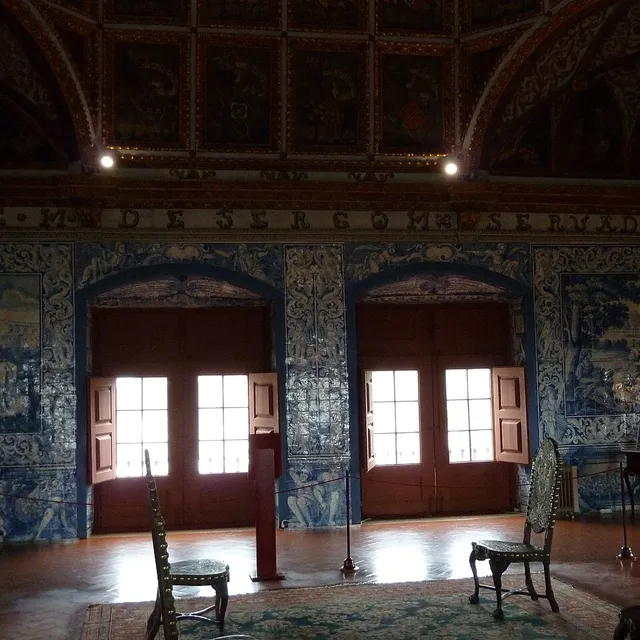
The Sala dos Brasões, or Coats of Arms Room, is the most celebrated single space in Sintra National Palace and one of the finest early-16th-century interiors in Europe. King Manuel I had it built between 1515 and 1518 as a heraldic statement of royal authority. Its magnificent wooden coffered dome carries 72 painted shields — the arms of the King and the principal noble families of Portugal — with the royal coat of arms at the centre and Manuel's children arranged around it. Below the dome, the walls are lined with 18th-century blue-and-white azulejo tiles showing courtly hunting scenes, from which the room takes its alternative name, the Stag Room. The acoustics beneath the dome are remarkable. Most visitors to Sintra National Palace spend longer here than in any other room on the circuit, and it regularly features among the palace's most-shared photographs.
Start with Sintra National Palace in the morning at the 09:30 opening, then finish at Pena Palace in the afternoon. Three reasons make this order work. Sintra National Palace sits in the cooler town centre, which is more comfortable under morning sun; Pena's yellow-and-red exterior looks its best in afternoon light; and Pena's fixed last-admission time gives you a firm deadline that absorbs any earlier train delays. Take lunch in Sintra town between the two — the restaurant cluster near Volta do Duche is a five-minute walk from Sintra National Palace. From the town centre the 434 bus reaches Pena in about 15 minutes, while a taxi or tuk-tuk takes 8 to 10 minutes up the hill. Allow at least three hours for Pena including its mountain park, and around 1.5 to 2 hours for the interior of Sintra National Palace.
No. Pena Palace requires a strict 30-minute timed-entry slot — Parques de Sintra publishes that requirement explicitly for Pena and turns away late arrivals. Palácio Nacional de Sintra does not run that system: you book a ticket for a date and enter during opening hours (09:30 to 18:00 last admission) without being held to a specific 30-minute window. Skip-the-line concierge tickets bypass the ticket-office queue at the main entrance — which on peak-season weekends in May to September runs 30 to 45 minutes — and let you walk straight in. The lighter crowd-control means flexibility on the day, but it also means peak-time queues can build quickly when several coach groups arrive at once.
You can walk in and buy a ticket at the entrance, but in peak season (May to September, weekends, and Portuguese public holidays) the ticket-office queue regularly runs 30 to 45 minutes. Pre-booking secures your day and lets you skip that queue entirely. We recommend booking 2 to 7 days ahead in peak months and any weekend; same-week or same-day booking in shoulder and winter seasons is usually fine. The ticket office also closes for a one-hour lunch break (12:00 to 13:00) — visitors who arrive at 12:15 without a pre-booked ticket find themselves waiting.
Yes. Parques de Sintra offers an on-site multilingual audio guide at the entrance for an additional fee, in Portuguese, English, Spanish, and French. For other languages, Parques de Sintra has integrated with the Zoomguide / CloudGuide app — visitors download the app to their own phone and access room-by-room content in additional languages. The guided narrative runs about 90 minutes if you follow every room. The on-site audio device is the most reliable choice for first-time visitors; the phone app works well if you prefer reading or want a language not stocked on-site that day.
There is a small café inside the palace complex serving coffee, soft drinks, pastries, and light snacks. For a proper lunch, walk five minutes from the palace door into Sintra's historic centre — the streets around Volta do Duche and Rua das Padarias are lined with restaurants ranging from traditional Portuguese to bakeries famous for Sintra's two regional pastries (queijadas and travesseiros, both worth trying). Eating in town is significantly better value than the on-site café and lets you rest somewhere with seating before your next stop. Restrooms are available inside the palace and at several points around the town square.
The standard palace ticket is valid for entry on the booked date during opening hours (09:30 to 18:00 last admission) and there is no enforced exit time once you are inside — you can take as long as you like to walk the circuit. The ticket is treated as a single entry; if you leave the palace and want to come back later the same day, ask the staff at the exit before you walk out, as re-entry is at the staff member's discretion and is not guaranteed. The streets and squares around the palace are free to wander independently of the ticket. We recommend allowing 1.5 to 2 hours from entry to exit and not booking anything else within that window.
Concierge tickets are issued for a specific date. If your circumstances change before the date, contact our concierge team at least 48 hours ahead by replying to your confirmation email and we will coordinate a rebook to any open slot in the operator's calendar.
Some sections yes, others no. The palace was built between the 14th and 16th centuries and retains narrow medieval doorways, stone thresholds, and short flights of steps between several rooms. Parques de Sintra's accessibility team can confirm which rooms are wheelchair-reachable on a given visit and arrange staff support — contact +351 21 923 73 00 or email the operator at least 48 hours before your visit. The 'Welcome Better' programme covers mobility, sensory, and cognitive accessibility needs. The town-centre approach to the palace itself is far easier than the mountain climbs at Pena Palace or the Moorish Castle.
Personal, non-flash, hand-held photography is permitted in nearly all rooms — the Magpie Room, Swan Room, Coats of Arms Room, kitchens, and chapel are all photographable. Flash is banned to protect the painted ceilings and the centuries-old azulejo tilework. Tripods, monopods, lighting rigs, professional video gear, and selfie sticks require pre-arranged written permission from Parques de Sintra. Drones are not permitted anywhere in the Sintra UNESCO landscape. Occasionally a single room is closed to photography during conservation or a temporary exhibition — these are signposted at the room entrance. The Coats of Arms Room is the most-photographed single space; most people aim straight up at the domed ceiling with its 72 heraldic shields. Mid-morning to early afternoon offers the best natural light through the room's high windows.
Palácio Nacional sits in the main square of Sintra's historic centre, Largo Rainha D. Amélia, and is signposted from the train station. The walk from Sintra railway station is about 1 kilometre and takes 10 to 15 minutes downhill on cobbled streets — or take the 434 tourist bus for one stop (Volta do Duche) if you have luggage or limited mobility. The two white conical chimneys are visible from most of the town centre and are the most reliable landmark; once you can see them you are five minutes away. Google Maps reliably routes pedestrians to the entrance on the south side of the building.
Standard tickets are self-guided. Parques de Sintra offers private guided tours at a higher price point and seasonal themed tours during major Portuguese cultural events — these are bookable directly through the operator's site and not through our concierge service. Many independent tour operators in Sintra include the palace as part of half-day or full-day Sintra walking tours; if you prefer a guide, our recommendation is to combine a private guide for the historic town and the palace exterior with a self-guided ticket for the interior circuit, since the palace's audio guide is excellent and licensed guides cannot lecture inside specific rooms.
Small daypacks and handbags stay with you throughout the visit. Large backpacks, hiking packs, and suitcases go through security screening at the entrance and may need to be checked in at the front-desk locker. Sintra train station has lockers if you arrive on a same-day return from Lisbon and want to drop bags before sightseeing — use those rather than carrying full luggage through the palace. Food and drink bottles are not permitted inside the rooms beyond a personal water bottle (refill points available in the gardens). Strollers struggle with the steps between rooms — a baby carrier is more practical for under-3s.
Booking through us costs more than queueing at the ticket office on the day, and the difference buys three things: your entry is secured before you fly, you walk past the ticket-office queue at the main door, and someone answers in your own language if plans change. The amount shown on the card is the amount charged, in your local currency, with no additions at the final step and no FX surprise. If the operator cancels your visit, you are refunded in full. On peak-season weekends, and for groups of three or more, the queue at the door is the part most visitors tell us they would rather not spend their morning on.
Sintra National Palace Tickets acts as a facilitator to assist international visitors in purchasing skip-the-line tickets directly from Parques de Sintra – Monte da Lua S.A., the official operator (the same operator that runs Pena Palace, the Moorish Castle, and the Monserrate estate). We do not resell tickets — we provide a personalised booking and support service in your own language. For those who prefer to purchase directly, the official ticket site is parquesdesintra.pt.
Prefer to buy from the palace operator directly? Their site is parquesdesintra.pt